The 2026 Commercial Interior Design Forecast: Key Trends for Architects & Designers
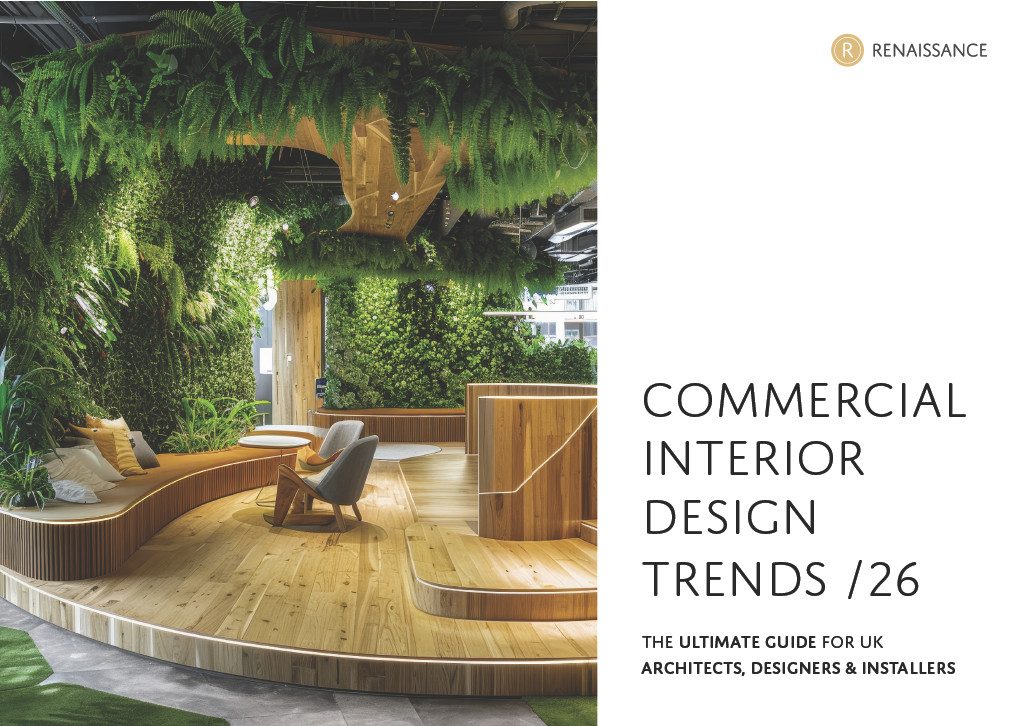
The UK commercial interior design landscape is undergoing a transformative shift. As we approach 2026, the demands placed on commercial spaces – from offices and retail to hospitality and healthcare – are evolving faster than ever. For architects, designers, and installers, staying ahead of these trends is no longer just an advantage; it’s essential for survival.
Driven by new consumer expectations, sustainable imperatives, and rapid technological integration, the 2026 brief is clear. It demands spaces that are not only aesthetically appealing but also flexible, responsible, and fundamentally human-centric.
Here is a preview of the core pillars shaping the future of UK commercial spaces.
1. the human-centric space: biophilia & biological lighting
Wellbeing is no longer a perk; it’s a primary performance metric. This trend moves beyond simple “wellness rooms” and integrates wellbeing into the very fabric of the building.
- Advanced Biophilia: This is more than just potted plants. 2026 sees a rise in sophisticated biophilic applications, including functional living walls that provide acoustic buffering and improve air quality. Designs are also incorporating more organic forms, natural patterns, and geological materials to create spaces that feel instinctively comfortable.
- Human-Centric Lighting (HCL): HCL strategies are becoming “non-negotiable”. The focus is on biological lighting, using tuneable white systems that mimic natural daylight patterns. This supports human circadian rhythms, which can improve productivity, reduce errors, and enhance occupant comfort.
2. sustainability AS STANDARD: MATERIAL HONESTY & CIRCULARITY
Eco-conscious design has become a non-negotiable client demand, with 72% of businesses now prioritizing sustainable materials. This trend is splitting into two key areas:
- Material Health: The focus is intensifying on material transparency and health. Low-VOC (volatile organic compound) paints, adhesives, and finishes are now standard requirements. As one industry expert in our report, Oscar Brooks of Moda Group, states, “Material honesty matters – recycled metals, reclaimed wood and verified low-emission finishes… so efficiency is designed-in, not retrofitted”.
- Circular Design: The principles of the circular economy are moving from niche to mainstream. This includes designing for disassembly, specifying products with high recycled content, and—critically—the adaptive reuse of existing buildings to preserve embodied energy.
“The winners will marry measurable sustainability with brand-level experience; that’s where demand – and value – now converge.”
Oscar Brooks, GRE & Co-Founder MODA Group

3. THE ‘PHYGITAL’ & FLEXIBLE EXPERIENCE
As digital life accelerates, physical spaces must offer what a screen cannot. This has led to two interconnected trends:
- Modularity & Adaptive Spaces: Flexibility is essential for maximizing a space’s value. Designs in 2026 will heavily feature modular furniture, movable fixtures, and reconfigurable layouts that allow a single area to serve multiple functions, reducing churn and waste.
- Sensory & ‘Phygital’ Design: To compete with e-commerce, physical spaces are becoming experiential landscapes. This includes creating “Instagrammable moments” and engaging all the senses through acoustic management, strategic scent diffusion, and rich tactile materials. This “phygital” (physical + digital) revolution requires technology to be seamlessly integrated, becoming invisible infrastructure rather than a clunky overlay.
Download the full 2026 interior design trends report
These trends represent a fundamental convergence of sustainability, wellbeing, and technology. The most successful commercial spaces of 2026 will be those that are viewed as strategic assets – environments that enhance brand perception, support efficiency, and deliver measurable business results.
Our complete 2026 Commercial Interior Design Trends Report provides a deep dive into all eight key trend categories, including detailed analysis on colour palettes, innovative window treatments, textiles, and insights from more industry experts.
To download yours for free, please complete the form below.
View Your Sector


